Rice University's premier undergraduate journal of scholarship in domestic and international policy.
Search
America “First”: A Return to Historical Imperialism in Venezuela
Cory Voskanian
Mar 8
6 min read
By: Cory Voskanian
Edited By: Sophia Cho
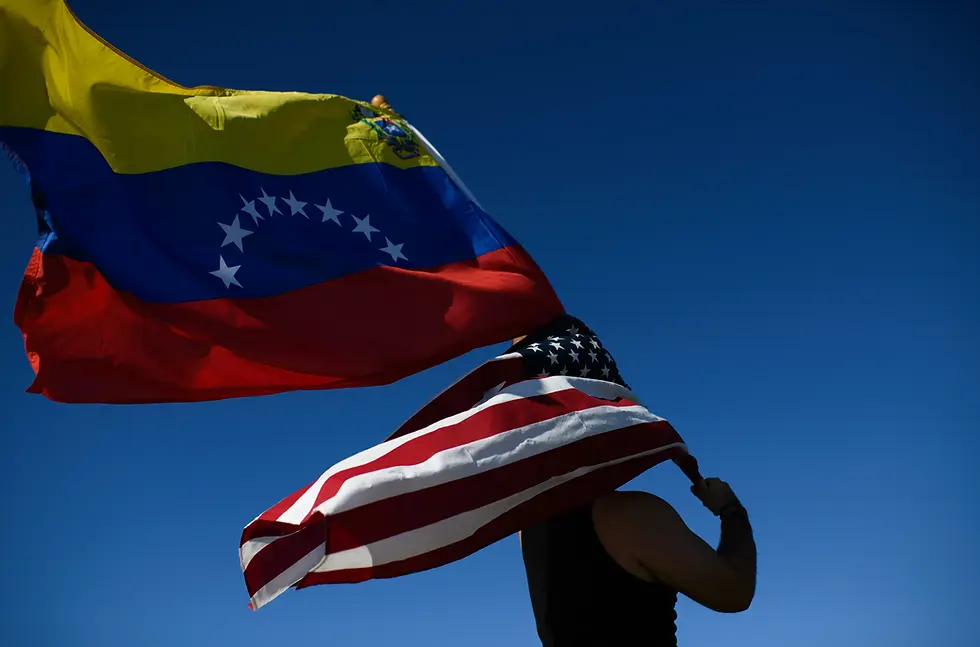
Photo by Mark Felix/Bloomberg/VOX
Venezuela has long been a key actor on the global stage, especially given its dominance in the oil industry (Paredes, 2026). The country’s industry control has naturally piqued the interest of other nations, particularly the United States’ Trump administration. What started as contention between leaders over natural resources quickly transformed into skirmishes on international waters, and has now reached a climax with the capture of Venezuelan president Nicolas Maduro earlier this year (Kupchan, 2026). Attacks on Venezuela follow a long history of U.S. interventions rooted in the virtues of the Roosevelt Corollary to the Monroe Doctrine, where the nation has the ability to exert international policing power in “flagrant cases of wrongdoing or impotence” (Roosevelt, 1904). The key issue with emphasizing such a virtue lies within the vague definitions of “flagrant” and “wrongdoing.” What started as a way for the U.S. to rehash its independence and protect domestic interests has quickly become a method for the state to justify its involvement in complex global politics. In order to protect hemispheric hegemony, the “Trump Corollary” of the Monroe Doctrine has placed emphasis on preventing both mass migration into the country and foreign ownership of key assets (Kupchan, 2026). Crucially, this posture is driven less by a coherent strategic vision than by domestic political impulses, and a return to U.S. industrial-era manufacturing prowess, one of Trump's core justifications for aggressive intervention, is simply not realistic in today's globalized economy (Kupchan, 2026). Repatriating supply chains will only exacerbate the current affordability crisis and will not necessarily create a sizable number of jobs in the service sector. The devolution from international cooperation into abrasive unilateral action under Trump’s “America First” campaign not only dangerously blurs the line between domestic and foreign interests but also suggests a progression into neo-imperialism. Recent developments in Venezuela present the need for several interrelated policy recommendations: the creation of legal rules surrounding international intervention, a return to multilateral international frameworks, and the cessation of harmful neo-colonial rhetoric.
To begin, an immediate redress from the U.S. government regarding the standards and importance of international norms is necessary to secure human rights and quell concerns about neo-imperialism. Human rights organizations like Amnesty International have noted that “when international law is ignored, human rights violations and deadly protracted conflicts often follow” (Amnesty International, 2026). Already, the ambiguity surrounding what constitutes “flagrant wrongdoing” has enabled discretionary and politicized intervention. U.S. policymakers should articulate clear legal criteria, consistent with international law, for when and how coercive action is permissible. Concretely, this could take the form of a reform to the War Powers Resolution, the existing mechanism through which Congress attempts to check presidential use of military force, or new standalone legislation that establishes binding thresholds for intervention (Greene, 2025). A reformed framework could incorporate elements such as demonstrated broad public support, clearly defined and attainable objectives with measurable endpoints, and safeguards ensuring that higher-priority security commitments are not compromised (Hillen, 1996). Enforcement mechanisms could include mandatory reporting requirements, sunset clauses on military authorizations, and judicial review triggers. Establishing transparent standards would prevent the conflation of domestic political interests with foreign policy decisions and limit executive overreach.
Continuing a pattern of cooperation, multilateral collaboration would recenter U.S. foreign policy within established international norms and institutions. Rather than relying on unilateral enforcement justified through vague doctrines like the Roosevelt or “Trump” Corollaries, the United States should pursue coordinated action through international institutions such as the United Nations Security Council and other regional partners. Such engagement would restore legitimacy to U.S. actions, reduce perceptions of neo-imperialism, and ensure that intervention thresholds are clearly defined and collectively enforced. At its core, international law relies on collective enforcement, and recent actions in Venezuela have shown how thin this veil is when competitive resources are at stake. Ignoring the existence of any sort of post-war world order suggests a frightening historical callback to the era of imperialism. For instance, at its peak, “the British Empire ruled vast territory without blanket military occupation. Control was typically exercised indirectly through trade monopolies, legal authority, and administrative influence, with force deployed selectively rather than continuously” (Dancy, 2026). The parallels to contemporary U.S. behavior in the Western Hemisphere are difficult to ignore. It is clear that this pattern of unilateral ambition and revisionist rhetoric threatens to erode both international norms and allied trust.
Critically, the United States has concrete material incentives to return to multilateral engagement. Unilateral action in Venezuela has already strained relations with key Latin American partners such as Mexico and Colombia, nations whose cooperation is needed for managing regional migration flows and trade (Stuenkel, 2025). More broadly, allies in Europe and Asia are watching (Reuters, 2026): if Washington signals that it will act outside of international institutions whenever economically convenient, those partners may accelerate efforts to build alternative security architectures if they fear aggression or coercion from the United States. (Majcin, 2026). Defection from multilateral norms carries real economic and geopolitical costs, not merely reputational ones. Conversely, reengaging through bodies like the UN Security Council would allow the U.S. to shape collective action on Venezuela in ways that still advance its strategic interests, including oil access, without triggering the broader backlash that unilateral coercion invites.
Beyond desires to control Venezuelan oil reserves, Trump has also made strong claims about annexing Canada and Greenland, creating further uncertainty among key allies (Kupchan, 2026). If Trump acted on these claims, “the consequences of a U.S. attack against a NATO ally would be disastrous. The United States and its European allies could go back to being adversaries—just as they were during the nineteenth century” (Kupchan, 2026). Moreover, U.S. involvement in Venezuela reflects a longstanding pattern of controversial intervention in the Western Hemisphere. Historical cases such as the Bay of Pigs invasion demonstrate that foreign intervention often fails to produce positive or intended outcomes. This event was not only deemed a political embarrassment but also resulted in “a misguided embargo that hasn't changed the regime and instead consolidated Cuba's relationship with the Soviet Union and now Russia” (Neuman, 2026). The lesson is not merely moral but strategic: coercive unilateralism tends to entrench the very adversarial governments it targets, while generating new enemies among formerly neutral parties. As aforementioned, it is of utmost importance that U.S. policymakers emphasize the importance of international cooperation. Explicitly, this can be done by renouncing annexationist rhetoric and limiting intervention in the Western Hemisphere to multilateral, legally-sanctioned actions. This may include reaffirming NATO commitments, rejecting unilateral territorial ambitions, and moving away from military coercion. Taking these actions will allow the United States to prevent the repetition of historically ineffective interventions and preserve the credibility of its alliances, and avoid the isolation that invariably follows imperial overreach.
Overall, engagement with Venezuela under the Trump administration has revealed that several policy changes are needed to preserve international law and regional stability. This includes steps like the creation of intervention-specific congressional protocol, a return to multilateral cooperation with concrete institutional commitments, and the full-stop of controversial annexation threats. The revival of the Monroe Doctrine through unilateral and coercive action reflects a broader shift toward neo-imperialism that weakens international alliances and blurs the boundary between domestic priorities and foreign intervention. The United States has clear material incentives to change course: declining allied trust, the risk of losing global financial credibility, and the well-documented tendency of interventionist overreach to produce the opposite of its intended effects. Historical precedent demonstrates that such approaches often produce counterproductive outcomes, generating adversaries rather than advancing U.S. interests. Only by recommitting to alliance-based restraint and international norms can the United States maintain its global credibility, avoid repeating past failures, and contribute to a more stable and cooperative international order.
The views expressed in this publication are the authors' own and do not necessarily reflect the position of The Rice Journal of Public Policy, its staff, or its Editorial Board.
References
Greene, Michael. “War Powers Resolution: Expedited Procedures in the House and Senate.” Congress.gov, 2025, www.congress.gov/crs-product/R47603.
Hillen, John. “American Military Intervention: A User’s Guide.” The Heritage Foundation, 2 May 1996, www.heritage.org/defense/report/american-military-intervention-users-guide-0.
Kupchan, Charles A. “Venezuela and Beyond: Trump’s ‘America First’ Rhetoric Masks a Neo-Imperialist Streak.” Council on Foreign Relations, 7 Jan. 2026, www.cfr.org/expert-brief/venezuela-and-beyond-trumps-america-first-rhetoric-masks-neo-imperialist-streak.
Majcin, Juraj. “From Venezuela to Greenland: Why Europe Must Respond to US Actions.” Www.epc.eu, 2026, www.epc.eu/publication/why-europe-must-respond-to-us-actions-in-venezuela-greenland/.
Neuman, Scott. “U.S. Interventions in Latin America and the Caribbean Haven’t Always Gone as Planned.” NPR, 2 Jan. 2026, www.npr.org/2026/01/02/nx-s1-5652133/us-venezuela-interventionism-caribbean-latin-america-history-trump.
Office of the Historian. “Monroe Doctrine, 1823.” State.gov, 2019, history.state.gov/milestones/1801-1829/monroe.
Paredes, Norberto. Lake Maracaibo: The Oil Region at Heart of Trump Plan to “Make Venezuela Great Again.” 30 Jan. 2026, www.bbc.com/news/articles/ckgnp8n40reo.
Reuters Staff. “World Reacts to US Strikes on Venezuela.” Reuters, 4 Jan. 2026, www.reuters.com/world/americas/world-reacts-us-strikes-venezuela-2026-01-03/.
Stuenkel, Oliver. “How Trump’s Venezuela Gamble Will Transform Latin America.” TIME, Time, 9 Jan. 2026, time.com/7344650/trump-maduro-venezula-latin-america/. Accessed 25 Feb. 2026.
Usmani, Sameena. “Trump’s Actions in Venezuela Violate International Law.” Amnesty International USA, 8 Jan. 2026, www.amnestyusa.org/blog/trumps-actions-in-venezuela-violate-international-law/.



Comments